Leadership built on field experience
By admin September 1, 2026 5:39 pm IST
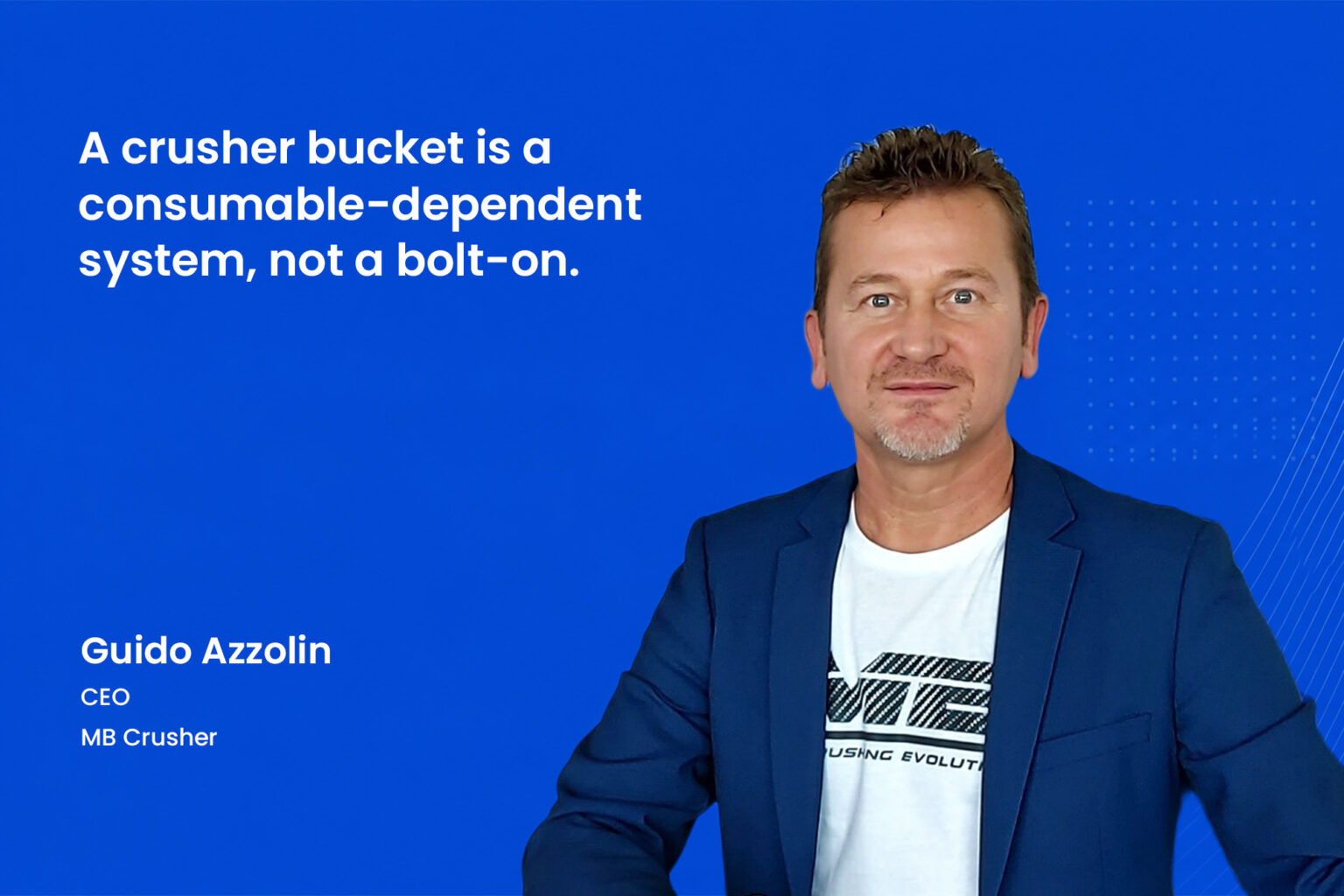
Twenty-four years after inventing the world’s first jaw crusher bucket, MB Crusher continues to strengthen its leadership through field-driven engineering, service readiness and application-specific innovation. CEO Guido Azzolin explains how decades of operational data shape product development and long-term competitiveness.
You invented the first jaw crusher bucket in 2001 and remain the category pioneer. How does being a 24-year-old market creator shape your R&D priorities and competitive strategy versus larger conglomerate entrants?
Inventing a category means you inherit responsibility for it. When we built the first jaw crusher bucket in 2001, there was no reference product to improve on and no established failure data to design against. Twenty-four years of field returns are now the asset. We know what breaks, in which material, at what hour count, in which climate — and that record is not something a broad-line manufacturer can shortcut by adding a crusher bucket to an existing catalogue.
That shapes R&D in a specific way. We do not develop toward specification sheets; we develop toward the conditions that actually destroy machines. Indian field data has directly influenced our work on sealing, dust ingress, and structural fatigue, because a machine working on basalt debris outside Nashik in May is exposed to conditions that no European test bench can replicate.
Competitively, our position is not that a conglomerate cannot build an attachment. It is that a crusher bucket needs service every 250 operating hours, and the machine’s value collapses without a spare parts pipeline and an engineer within reach of the site. A crusher bucket is a consumable-dependent system, not a bolt-on. Depth in one category buys the service infrastructure to support that. Breadth across many categories usually does not.

The BF90.3 S4 (updated version) remains your flagship crusher bucket across 21+ tonne excavators. How has the S4 iteration improved and what measurable performance gains justify the upgrade cycle?
The S4 generation was not a redesign for its own sake. It consolidated changes that emerged from a decade of warranty data and field observations, and the honest way to describe it is as incremental engineering rather than a new machine.
The material improvements are in the areas that determine uptime rather than headline throughput. Structural reinforcement at the points where fatigue cracking historically appeared. Improved sealing and protection of the drive assembly against dust and fines, which is the dominant failure mode in Indian quarry and demolition work. Refinement of the hydraulic circuit so the unit holds back pressure under ten bar across the range, which matters because it means the carrier’s hydraulics are not being punished to run the attachment.
The commercially significant change is that an hour meter is now supplied as standard on every machine. That sounds minor. It is not. It converts service from something a contractor remembers to something the machine tells him, and it means the 250-hour interval is actually observed. Most premature jaw and bearing failures we see in India are due to missed service, not design failures.
Coal mines use MB units for coal sizing and for separating silica rock (bone coal). What are the specific durability challenges in mining and how do mining deployments differ from construction recycling?
The two applications look similar and behave completely differently. Construction recycling is intermittent and dirty. Feed is mixed — concrete, brick, rebar, soil, whatever the structure was made of. The machine works in short cycles, often in confined urban space, and the operator is managing contamination as much as crushing. Rebar and uncrushables are the practical risk, which is why the safety systems that release the chamber on an uncrushable matter more here than raw output does.
Mining is the opposite: continuous duty on consistent feed. In coal, the units are sizing rather than reducing hard rock, so the mechanical load is lower than most people expect. The durability challenge comes from the inclusions. Bone coal and silica bands arrive intermittently in an otherwise soft feed, so the machine runs at low load and then absorbs a shock. That cycling is harder on the structure than sustained hard-rock work, and it is where frame integrity and jaw-seating design are tested.
Coal fines are also aggressive toward seals and, in confined workings, a dust-management issue rather than a nuisance.
Operationally, the difference is duty cycle. A recycling contractor buys a crusher bucket for flexibility across job types. A mining operator buys it for capacity at distributed faces where sending material to a fixed plant makes no sense.

In western India, you deployed a BF60.1 S4 on a JCB 140 excavator crushing basalt debris for recycled aggregate. What were the throughput and daily revenue generated, and has this model been replicated at other demolition sites?
The site was a demolition operation working basalt debris, and the setup was deliberately modest: a BF60.1 S4 on a JCB 140. That pairing is the point of the story. The contractor did not buy a carrier for the job — he mounted the attachment on the machine already standing on site.
Output ran at approximately, producing recycled aggregate that went straight back into the works instead of leaving the site as debris and returning as purchased material. The commercial effect sits on both sides of the ledger: cost removed on disposal and haulage, and value created from material that had already been paid for once.
On replication — What travels from that site is not the numbers; it is the configuration logic. Match the attachment to the carrier the contractor already owns, and the capital question changes shape entirely.
Service and spare parts availability are critical in emerging markets. How are you ensuring parts availability in India’s tier-2 and tier-3 cities, and what is your typical lead time for a replacement jaw plate or rotor shaft?
This is the part of the business that decides whether a customer buys a second machine, and it is where a price-led competitor eventually fails.
A crusher bucket is not a machine you sell and leave. It needs service every 250 operating hours. If the parts are not in the country and no engineer is available to reach the site, the attachment ceases to be an asset within a year. That is the honest state of the category in India, and we say it plainly to customers because it is the standard we want to be judged against.
Our approach is to stock in-country rather than ship on demand from Italy. Wear items — jaw plates in particular — are held in India, not ordered against a failure. Service coverage is built out through state-level engineers and exclusive dealers who carry both machines and spares, and we have been concentrating investment on the partners who can actually respond rather than spreading it thin.
Geographically, the priority is the difficult corridors: the North-East, Uttarakhand, Himachal, Jammu and Kashmir. Those are the sites where on-site processing has the highest value and the worst logistics, which means they are exactly where the parts pipeline is tested.